


10 warehouse risk hotspots: where do the biggest safety risks occur?
A warehouse can look organised and well structured while still containing a variety of safety risks. Wherever forklifts, pedestrians, goods and trucks come together, small uncertainties can quickly lead to an incident. Think of a blocked pedestrian route, a blind intersection or a pallet that has not been positioned correctly in a rack.
The Code Gezond en Veilig Magazijn identifies ten locations where risks often come together. Not every warehouse has the same layout or activities, but most businesses will recognise several of these hotspots. Use this list as a starting point for a safety inspection and a concrete action plan.
Are you dealing with recurring damage, unclear traffic zones or increasing amounts of time spent on repairs and follow-up? This may indicate that your warehouse is not adequately protected against impacts. Read about the five signs that your warehouse is not adequately protected against impact damage before mapping your own risk hotspots.

1. Loading docks and entrances
Loading docks bring trucks, forklifts, warehouse employees and visitors together. Potential risks include a truck unexpectedly driving away, entrapment around the dock leveller and collisions between vehicles and people.
Clearly define who is allowed to be where during loading and unloading. Also check the lighting, vehicle restraints and the connection between the outdoor area and the warehouse. A clear separation between pedestrian and vehicle routes prevents a great deal of uncertainty.
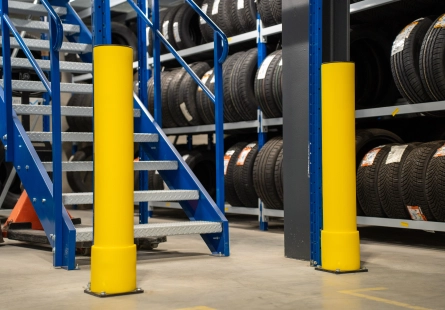
Loading docks often require a combination of measures. These may include dock gates, protective bollards, barriers and a clear separation between pedestrians and internal transport. Find out which type of impact protection is suitable for a loading dock.
2. Aisles
Aisles are usually intended for internal transport but are often also used by order pickers, maintenance technicians and visitors. The more functions an aisle combines, the greater the risk of a collision.
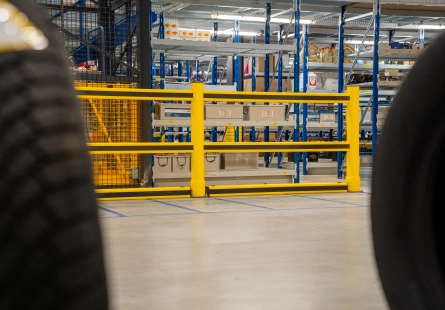
First determine whether pedestrians actually need to be present in this area. Use a traffic management plan to specify which routes are intended for forklifts, pallet trucks and pedestrians. If physical separation is required, pedestrian barriers provide a clear division between pedestrian walkways and internal transport routes.
3. Racking and storage systems
An impact against a rack can compromise both the stability of the structure and employee safety. Damaged or incorrectly positioned pallets can also cause goods to fall.
Check for damage to uprights, beams and protective components. Make sure pallets are stacked correctly, do not protrude and are suitable for their storage location. If damage keeps recurring, do not simply repair it: investigate the cause as well. Recurring damage involves considerably more costs than the repair alone.
Discover how much a single forklift collision can really cost.
4. Passages between warehouse zones
Passages are where traffic flows from different areas come together. Employees leaving a chilled or frozen area may temporarily have reduced visibility because their glasses fog up. A major change in light intensity can also affect visibility.
Keep passages clear and easy to oversee. Pay attention to doors that can suddenly open into a vehicle route, obstacles that block visibility and vehicles approaching at excessive speed. A separate pedestrian door or adjusted traffic direction can help reduce the risk. Safety gates can help make passages more controlled and easier to oversee.
5. Intersections
At intersections, traffic flows literally come together. Racking, pallets and other obstacles can restrict visibility, while speed increases the potential consequences of a mistake.
Clear right-of-way rules, mirrors, line markings, sufficient lighting, floor markings and signage significantly reduce the risk of collisions. Also check whether employees know and follow the rules. A stop line alone does not make an intersection safe.
6. Pedestrian and vehicle routes
Blocked pedestrian routes can force employees to step into vehicle lanes. Clearly define where goods may be temporarily stored and how quickly an obstruction must be removed.
Also look at long walking routes, unnecessary detours and locations where employees tend to take shortcuts. A warehouse layout that does not match day-to-day operations can encourage unsafe behaviour.
7. Packing and repacking stations
Packing and repacking stations combine the supply, inspection, packaging and removal of goods. This creates a lot of movement around a location where employees need to remain focused on their work.
Ideally, position these workstations away from the busiest vehicle routes. Where possible, separate the supply and removal of goods from the actual workstation. Make sure there is sufficient space, an appropriate working height and clear instructions for temporary employees.
8. Platforms and raised work floors
Platforms create risks relating to falls, falling goods and overloading. Check the maximum load capacity and make sure it is clearly displayed.
Keep floors, guardrails, stairs, gates and landings in good condition. Use mesh partitions to separate areas and reduce the risk of falls or objects falling through. Safety nets can help catch falling goods. The solution should be appropriate for both the structure and the way employees handle the goods.
9. Battery charging stations
Battery charging stations bring electricity, batteries, charging equipment and internal transport together. Depending on the type of battery, risks can include fire, explosion, electrical incidents, leaks or hazardous gases.
Keep the charging area tidy and free from unnecessary materials. Make sure cables do not create a trip hazard and that employees know how to report defects, leaks or damage. Proper maintenance and practical instructions are essential in this area.
10. Company premises
Accidents also occur outside the warehouse and could often have been prevented. Trucks, cars, forklifts, cyclists and pedestrians sometimes use the same space without clear rules.
The basics are often missing: no traffic management plan, no separation of traffic flows, no one-way system and no markings. Map the routes across the entire site. Pay particular attention to gates, parking areas, loading zones, intersections and the transition between outdoor and indoor traffic.
From risk hotspot to concrete action
A safe warehouse environment is created through a combination of thoughtful design, clear traffic rules, well-maintained infrastructure and engaged employees.
Use these ten hotspots during a safety inspection and record, for each area, what causes the risk and who or what is involved.
MDO Group helps you identify high-risk areas and develop appropriate measures. We help you make your warehouse safer and easier to navigate, supporting you from inspection and advice through to supply and installation.