


How can you make your warehouse safer? 8 practical steps
A safe warehouse requires more than sturdy racking and clearly visible safety markings. The layout, internal transport and daily working practices also determine how safely employees can carry out their tasks. But where should you start when you want to improve warehouse safety?
This step-by-step guide explains how to identify safety risks, which measures you can take and how to make safety an integral part of your warehouse management.
Step 1. Identify safety risks in your warehouse
A safe working environment starts with understanding the risks. Walk through your warehouse systematically and assess the situation from the perspective of both warehouse employees and operators of material handling equipment.
Pay particular attention to loading and unloading areas, intersections, passageways and locations where pedestrians and forklifts cross paths. Damaged racking, blocked walkways and poorly visible obstacles also deserve attention.
Record where risks occur, what their potential consequences are and which safety measures are already in place. Then assess which situations require the most urgent attention. Use this information as part of your risk assessment and the associated prevention policy.
Practical tip: take photos of potentially hazardous situations during your warehouse safety inspection and record their locations. This makes it easier to follow up on improvements and check whether the measures taken are effective.
Want to know which areas deserve particular attention? Read our blog about the biggest warehouse safety risk hotspots.
Step 2. Check your warehouse racking for damage
Warehouse racking is subjected to daily loads and can become damaged by forklifts, incorrectly positioned pallets or improper use. Even minor damage can affect the stability and safety of the installation.
Have you noticed a bent upright, a missing locking pin or another type of damage? Have the situation assessed before the affected racking is returned to normal use. Depending on the severity of the damage, it may be necessary to unload the installation immediately and take it out of service.
In addition to internal checks, periodic inspections by a qualified specialist are important. We provide warehouse racking inspections and safety checks, identifying damage and other areas requiring attention.
Step 3. Store goods safely and prevent falling loads
The condition of your warehouse racking is not the only factor that determines how safely goods are stored. The way pallets, boxes and other materials are positioned also plays an important role.
Check that goods are stacked securely and that pallets are in good condition. Damaged pallets, protruding loads or incorrectly positioned goods can increase the risk of falling materials. Take into account the permitted load capacity of the racking and the suitability of the storage equipment being used.
Also pay attention to the loading, unloading and movement of goods. Ensure that employees use the appropriate equipment and that heavy or difficult-to-handle loads can be moved safely.
Practical tip: during a warehouse inspection, do not just check the racking itself. Look upwards as well. Are pallets positioned correctly? Are any goods protruding? Could materials fall from the storage levels?
Step 4. Separate pedestrians from internal transport
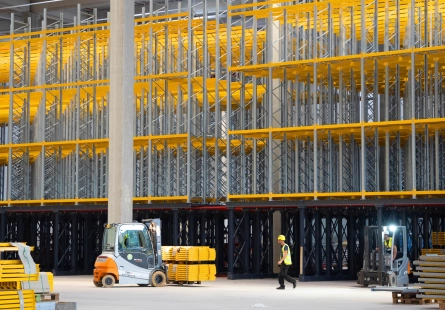
Where forklifts, pallet trucks and pedestrians share the same space, there is a risk of collisions. Particularly at poorly visible intersections and passageways, dangerous situations can arise.
Check whether pedestrian walkways and vehicle routes are sufficiently separated. Adjusting the warehouse layout or introducing one-way traffic can help reduce crossing movements.
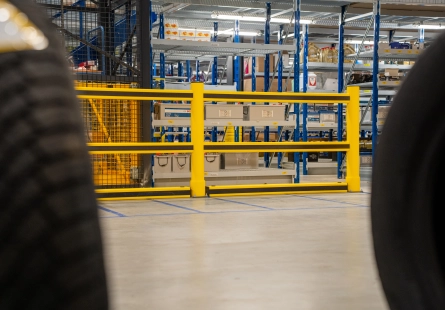
In areas where pedestrians and vehicles operate close to each other, physical separation may be necessary. Consider pedestrian safety barriers that prevent employees from unexpectedly entering vehicle routes. Floor markings alone do not provide sufficient protection in every situation.
Also check whether passageways are wide enough for the material handling equipment in use and whether operators have sufficient visibility of their surroundings.
Practical tip: observe your warehouse during a busy working period. This will help you identify where employees need to move out of the way, where routes intersect or where goods obstruct visibility.
Step 5. Protect racking and work areas against collisions
Not all collision risks can be eliminated by changing the traffic layout. Rack uprights, columns, machines and passageways remain vulnerable to internal transport in certain locations.
Targeted impact protection helps limit damage and the potential consequences of a collision. The most suitable type of protection depends on the location, the type of vehicle and the risks associated with a possible impact.
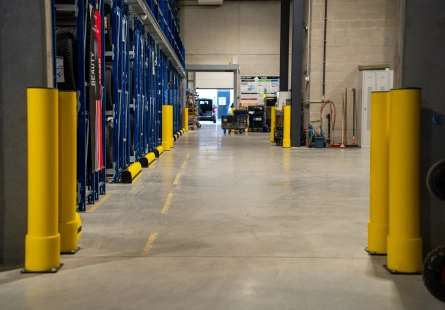
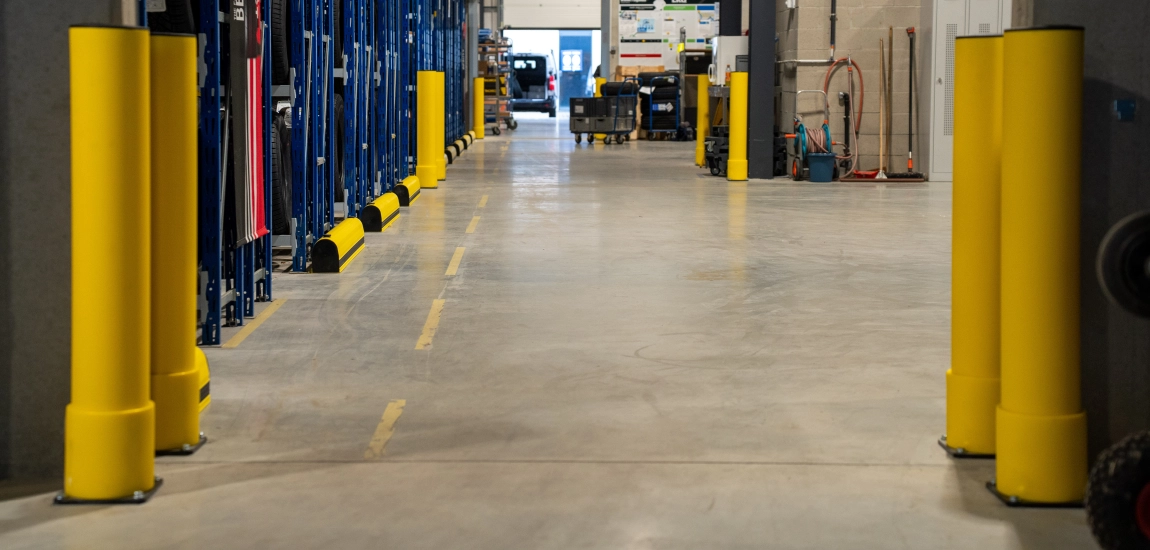
For example, rack protection can be installed around vulnerable uprights, while safety barriers can help separate work areas from vehicle routes. Protective bollards or guards may be suitable near passageways or technical installations.
We offer a range of plastic impact protection solutions, tailored to the application and risks within your warehouse.
Impact protection does not replace safe vehicle routes or clear traffic rules. Reduce risks wherever possible first, then select additional protection for vulnerable areas.
Need advice? We are here to help.
Step 6. Provide clear markings and load capacity signs
A safe warehouse layout is only effective when employees know where they are allowed to walk, drive and work.
Use clear signage to identify vehicle routes, pedestrian areas, hazardous passageways and other important locations. Make sure markings remain clearly visible and are not obstructed by stored goods.
Load capacity signs on warehouse racking are also important. These signs indicate the maximum permitted weight for a rack or individual storage level. This helps employees understand the allowable loads and prevent overloading.
Also check that emergency exits, evacuation routes and safety equipment are clearly identifiable and accessible. A marked route offers little value if pallets or other materials are regularly placed on it.
Include signage and load capacity signs in your regular warehouse safety checks.
Step 7. Involve employees in safe working practices and damage reporting
Even a carefully designed warehouse can become unsafe when procedures are not followed or damage goes unnoticed.
Make sure employees understand the applicable safety rules and know how to report hazardous situations. Provide clear instructions on the use of material handling equipment, the safe storage of goods and keeping work areas clear.
Also pay attention to temporary employees and visitors. They may not yet be familiar with the warehouse layout or internal traffic rules.
Make reporting damage and near misses as straightforward as possible. A minor collision with a rack may not immediately cause visible problems, but it may still require a technical assessment.
Practical tip: our Warehouse Inspection Application (WIA) allows employees to inspect warehouse racking themselves and digitally record damage. This helps you maintain an overview of identified defects and the follow-up of repairs.
Discuss recurring reports with your employees. They often know exactly where daily operations create unnecessary risks.
Step 8. Carry out regular inspections and follow up on improvements
A single safety inspection is not enough. The layout and use of a warehouse are constantly changing. New storage requirements, different material handling equipment or additional racking can introduce new risks.
Therefore, develop a clear improvement plan based on your risk assessment. Determine which measures should take priority, who is responsible for implementing them and when the results will be reviewed.
Give priority to risks that could have serious consequences. Some situations require immediate action, while other improvements can be incorporated into maintenance or investment planning.
Also schedule periodic inspections and have warehouse racking inspected in accordance with the applicable requirements. The European standard EN 15635 provides an important framework for the use, inspection and maintenance of steel storage systems.
After making adjustments, check whether the selected measures work in practice. This ensures that warehouse safety becomes an integral part of daily operations rather than a one-off project.
Checklist: how safe is your warehouse?
Want to quickly identify where improvements may be needed? Use these seven checkpoints as a starting point for your next warehouse safety inspection.
- The main safety risks have been identified and assessed.
- Warehouse racking is checked regularly, and identified damage is followed up.
- Pedestrians and internal transport are separated where necessary.
- Vulnerable areas have appropriate protection against impact damage.
- Safety signage, load capacity signs and evacuation routes are clear and accessible.
- Employees understand safety procedures and report hazardous situations.
- An up-to-date improvement plan is in place, with assigned responsibilities and review dates.
Unable to tick off one or more of these points? Investigate the associated risks and determine which measures are necessary. This checklist is a practical tool and does not replace a comprehensive risk assessment or a professional safety evaluation.
Want to make your warehouse safer? We are here to help
Warehouse safety requires a combination of a well-designed layout, properly maintained racking and suitable protective measures.
We support you with various aspects of this process, including warehouse racking inspections, the repair or modification of storage systems and the installation of impact protection. We assess the specific situation in your warehouse and explore opportunities to reduce risks.
Would you like to discuss which improvements could make a difference in your warehouse? Feel free to contact us. We will be happy to explore how we can help you create a safer warehouse environment.