


What type of collision protection do you need? A decision guide by risk zone You want to better protect your warehouse, but where do you start?
Do you need rack protection or a full guardrail? Is a protective post sufficient next to a machine? And how do you ensure that employees can safely cross a busy traffic route?
Collision protection comes in various forms. The solution that’s right for your warehouse depends primarily on the zone you want to protect, the traffic that passes through it, and how the space is used on a daily basis.
In this selection guide, you’ll discover which type of collision protection is suitable for racks, machines, pedestrian walkways, buildings, technical installations, passageways, and loading zones.
Translated with DeepL.com (free version)
Which impact protection should you use, and where?
In short:
- Racking and rack uprights: upright and frame protection
- Machines and technical installations: safety barriers, bollards or kerbs
- Pedestrian walkways: pedestrian barriers and safety barriers
- Crossings and passageways: safety gates
- Columns, walls and corners: column and corner protection
- Longer traffic routes and work zones: traffic and safety barriers
- Doors and low passageways: height restrictor barriers
- Loading docks and entrances: dock gates, bollards and barriers
MDO Group offers a range of plastic and steel impact protection for these applications. The solution is tailored to your warehouse layout, your vehicles and your day-to-day processes. View the full range of impact protection.
Start with the zone you want to protect
Choosing impact protection does not start with a product, but with a practical question: What can be hit in this location, and from which direction can the impact come?
A rack upright is usually hit from the side or the front. A machine may need protection along a greater distance. On a pedestrian walkway, impact protection is not the only consideration: a clear separation between people and vehicles matters just as much.
By assessing each zone individually, you avoid installing protection that does not match the actual risk.
Which protection should you install for warehouse racking?
Are the ends of your racks located along a traffic route? Do forklifts have to manoeuvre close to the uprights? Or are rack uprights positioned right next to a bend? In that case, the lower sections and the ends of the racks are the most vulnerable. Depending on the position, you can opt for:
- upright protection around an individual rack upright;
- frame protection at the end of a row of racking;
- a pallet stop or backstop to prevent pallets from being pushed too far back.
Upright protection is suitable when one specific upright is mainly at risk. Frame protection shields a larger part of the rack end and is therefore a better fit for end-of-aisle positions along busy traffic lanes.
A pallet stop does not protect against the same type of impact, but prevents pallets from being pushed through too far. This helps protect the infrastructure or walkway behind the racking.
Explore the various options for rack protection in your warehouse.
How do you protect machines and technical installations?
Machines, charging points, control cabinets and pipework usually call for a solution that prevents vehicles from getting too close. The right protection depends on the size of the installation.
Protection for a single vulnerable point
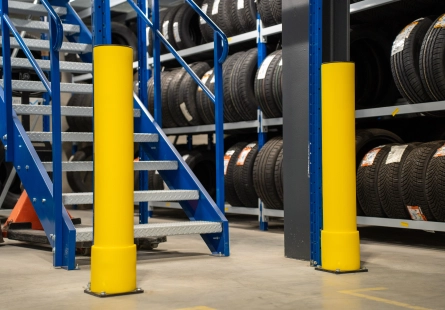
Do you want to protect a machine corner, control panel, pipe or technical cabinet? A bollard or protective hoop may well be enough.
This compact solution is suitable when:
- only one point needs protection;
- the installation must remain accessible;
- there is little space available;
- vehicles mainly approach from one direction.
Explore the options for bollards and kerbs.
Protection for an entire machine or production line
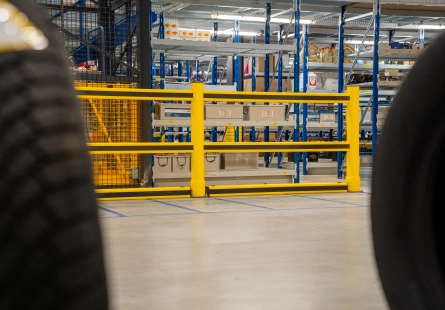
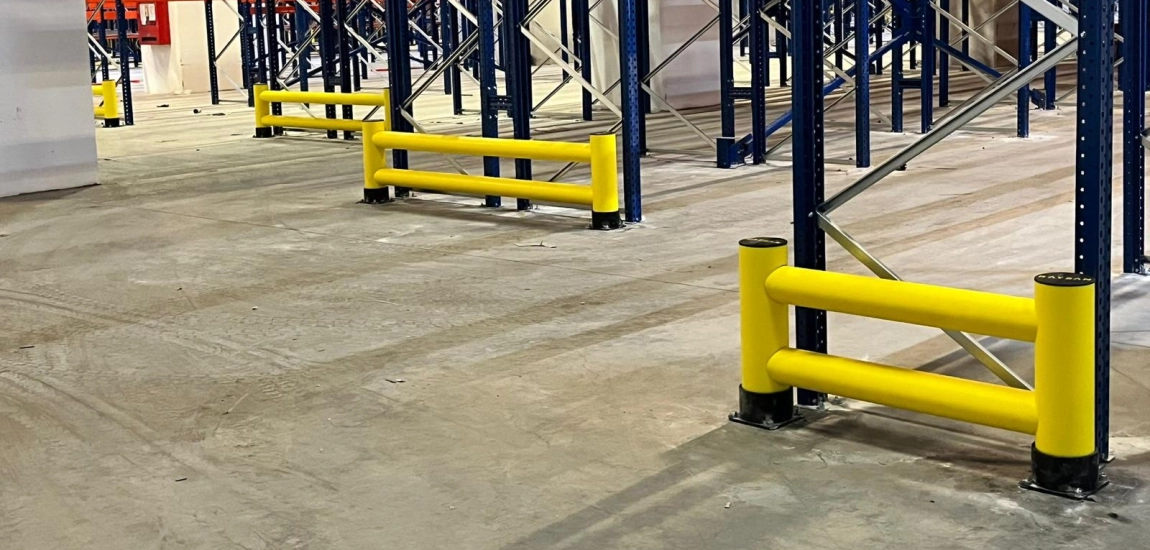
Do you need to shield a longer side? In that case, a safety barrier provides a continuous line of protection.
A safety barrier is a good fit around, for example:
- production machinery;
- conveyors and roller tracks;
- loading installations;
- cooling and technical installations;
- work zones next to a traffic route.
Modular safety barriers can be built up over a longer distance and adapted later on when the layout changes. MDO Group offers various heights and versions, depending on the intended application.
How do you make pedestrian walkways safer?
Does a pedestrian route run right alongside a forklift traffic route? A line on the floor is not always enough to clearly separate the two traffic flows.
With a flexible barrier for safe pedestrian walkways, you create a physical separation between employees and internal transport.
Pedestrian barriers are particularly suitable for:
- walkways through the warehouse;
- routes between production and storage zones;
- visitor entrances;
- routes to offices, changing rooms or staff areas;
- locations where employees walk close to forklift traffic.
Do make sure the protected walkway follows a logical route. If the protected walkway involves a long detour, there is a risk that employees will still take a shorter route through the traffic zone.
Which solution should you use at a crossing or passageway?
A pedestrian barrier protects a walkway, but at some point employees need to be able to leave that route or cross a traffic lane.
A safety gate is the solution for this.
MDO Group offers, among others:
- pedestrian gates and swing gates
- sliding gates
- dock gates
- belt gates
A pedestrian gate can slow employees down before they enter a traffic zone. A sliding gate is suitable where a wider passageway is required. At loading docks, a dock gate helps control access to the loading area.
The gates can be installed between existing barriers or used as a standalone passageway. Thanks to their modular construction, they can be adapted when the situation changes. Explore the various safety gates for warehouses and work zones.
How do you protect columns, walls and corners?
Load-bearing columns and building corners are sometimes located in the middle of a traffic flow, right next to a passageway or at the end of a manoeuvring area. Which protection is suitable depends on the shape and the position.
Column protection
Column protection is installed around a free-standing column. Depending on the direction of traffic, protection may be needed on one, two or several sides.
This is particularly relevant for:
- load-bearing columns in traffic routes
- pillars at parking and loading areas
- columns between storage zones
- structures that can be hit from several directions
Corner protection
Corner protection is suitable for protruding corners of walls, machines, cabins and technical rooms.
The protection follows the shape of the corner and absorbs contact before the vehicle hits the structure behind it.
View the available versions of column and corner protection.
When should you choose a safety barrier?
A bollard protects a single point. A safety barrier protects an entire line or zone.
Safety barriers are therefore suitable when you want to:
- mark out a long traffic route;
- separate a work zone from forklift traffic;
- place several machines behind a single line of protection;
- protect a wall or installation along a greater length;
- guide vehicles along a fixed route.
Combinations are also possible. A safety barrier can be supplemented with a handrail for pedestrians, for instance, or with a kerb at floor level.
With plastic traffic and safety barriers, you create a continuous and highly visible separation.
How do you protect doors and low passageways?
Not every collision happens at floor level. A raised forklift mast, protruding load or over-height vehicle can also hit the top of a passageway. In these zones, a height restrictor barrier is the appropriate solution.
Height restrictor barriers are used at, among others:
- sectional doors
- entrances with limited headroom
- loading areas
- passageways beneath pipework or structures
- internal routes with differences in height
A height restrictor barrier warns the driver before the vehicle reaches the door or structure. Explore the options for height restriction at doors and passageways.
Which impact protection suits a loading dock?
At a loading dock, several risks come together. Lorries reverse, forklifts move goods and employees move between indoor and outdoor areas.
That is why a combination of solutions is usually needed:
- bollards at door jambs and building corners
- barriers along vulnerable installations
- a dock gate on the inside
- pedestrian barriers along walkways
- height restriction at low entrances
- kerbs or guidance at floor level
Do not look at the loading bay itself alone. The approach route, waiting area, access door and the position of employees should all form part of the safety set-up.
Do you need a single product or a complete safety plan?
Sometimes a single bollard is enough. In other situations, a combination of rack protection, safety barriers, pedestrian barriers and gates is required.
That depends on questions such as:
- Which vehicles use the zone?
- From which direction could they hit the object?
- How much manoeuvring space do drivers have?
- Do employees walk through or alongside the zone?
- Does the installation need to remain accessible?
- Does the warehouse layout change regularly?
- Is the solution intended for indoor or outdoor use?
By answering these questions zone by zone, you arrive at a protection plan that matches your day-to-day operations. This prevents products from being installed in isolation, leaving vulnerable points between the various protected zones.
From risk zone to the right solution
You do not have to work out for yourself which type, height or version you need. MDO Group assesses your warehouse environment and helps you choose the right solution based on layout, traffic flows, vehicles, infrastructure and future changes.
From advice and design through to delivery and installation: we provide a solution that suits your warehouse.
View all plastic impact protection from MDO Group, ask an expert for help or request a quote for impact protection.