


Plastic or steel? How to choose the right impact protection for your warehouse
You know that a vulnerable area in your warehouse needs protection. The next question soon follows: do you choose steel or plastic?
Both materials can protect racking, machines, columns and other infrastructure, but they respond differently to impact. That difference determines which solution is the best fit.
The right impact protection is not automatically the strongest or the most flexible option. It needs to match the expected impact, the environment and what happens to that energy after a collision.
What is the difference between steel and plastic impact protection?
The main difference lies in the way both materials absorb an impact.
Steel impact protection forms a strong, rigid barrier. During an impact, the steel resists the force. If the force is high enough, the material may deform and part of the load may be transferred to the fixings and the floor.
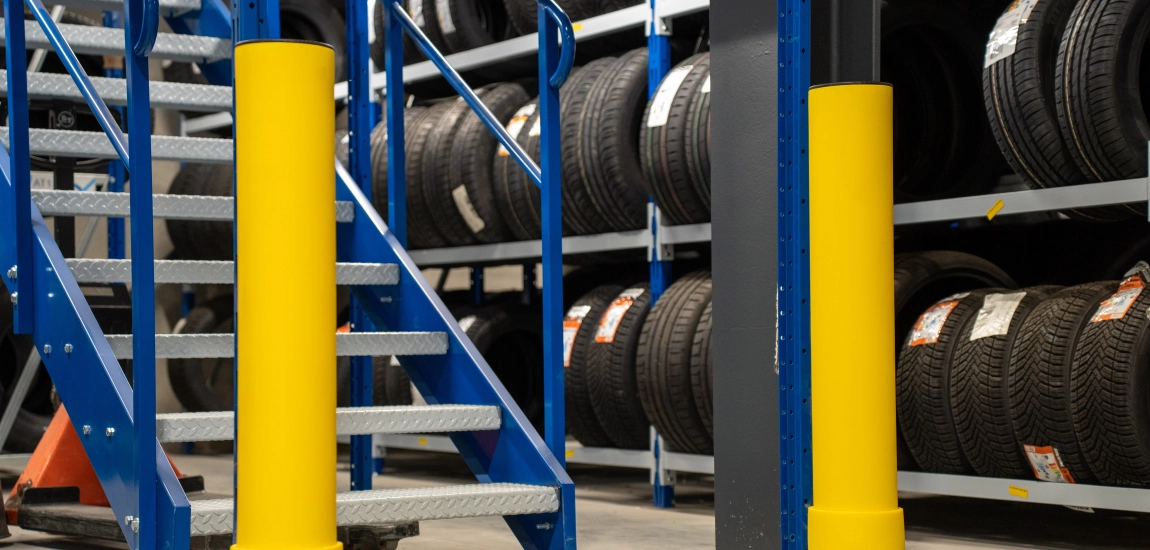
Plastic impact protection works more flexibly. The material is designed to deflect and absorb impact energy. Afterwards, the protection can return to its original shape.
Neither material is therefore automatically better. They simply protect in different ways.
When is steel impact protection suitable?
Steel is a logical choice when you want to create a fixed and robust physical barrier.
This can be relevant, for example, in areas that need to be clearly separated from internal transport or where a rigid construction is preferred.
With steel, however, it is important to look beyond the barrier itself. The protection, fixing points and floor together form one system. The force of an impact can therefore also affect the fixings and the surface underneath.
That is why not only the dimensions of the protection are important. Its position, the substrate and the direction from which an impact may occur also need to be considered.
Do you already have steel protection that is functioning well? Then it does not automatically need to be replaced. The key question remains whether the current protection still matches the risk at that location.
When is plastic impact protection an interesting option?
Plastic is particularly suitable when you want the protection to absorb the impact and flex during a collision.
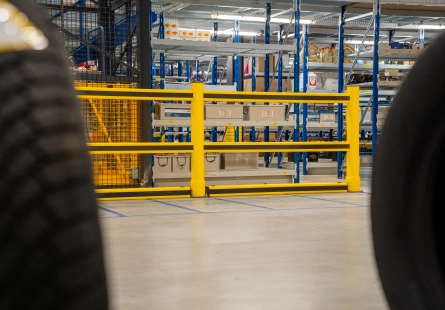
This can be relevant in areas where forklifts or other internal transport regularly manoeuvre close to vulnerable infrastructure and occasional contact cannot be completely ruled out.
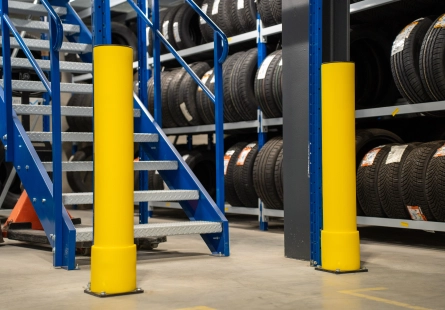
Within our range, we work with Raysan plastic impact protection, among other solutions. These systems are designed to absorb impact energy and then return to their original shape.
This difference can also be relevant from a maintenance perspective. After a light impact, flexible protection does not necessarily show the same permanent deformation as a rigid steel barrier.
Plastic also does not rust. This can be an advantage in environments where moisture, cleaning or weather conditions play a role.
View MDO Group’s plastic impact protection
Look beyond the purchase price alone
The purchase price does not tell the whole story.
Is the protection installed at a busy manoeuvring point and regularly hit? Then potential deformation, repairs, replacement and inspection of the fixings also need to be taken into account. Damage around the protected area may also affect daily operations.
At a quieter location, the balance may be very different.
The relevant question is therefore not only:
How much does this impact protection cost?
But above all:
What happens after it is hit?
That provides a better indication of the operating costs and the long-term suitability of the solution.
Start with the situation, not the material
Unsure whether to choose steel or plastic? It can be tempting to compare product properties side by side and then select a winner.
We prefer to reverse that process.
First, we look at what you want to protect, the type of impact that may occur and how the area is used on a daily basis. The consequences of damage also matter. A machine that is essential to your production process, for example, requires a different assessment from a less critical wall.
Only then do we determine which material and configuration are suitable.
Would you first like to see which type of protection suits different risk areas? Use our impact protection selection guide.
The right choice starts with your warehouse
The best choice is not about which material appears strongest on paper. It is about how the protection needs to respond to the type of impact that can occur in your warehouse.
We assess the risk area, advise you on suitable protection and can also take care of professional installation.
Unsure which solution is right for your warehouse? Let us assess the situation and choose based on the actual risk.
Contact us or request a quotation directly.